Das Produkt befindet sich in einem externen Lager. Die Lieferfrist: ca. 7-9 Werktage.. Mehr Info
Versandoptionen - Wird im Checkout ausgewählt
Versand mit DHL - PaketShop
3,57
Versand mit DHL zur Adresse
11,90
Versand mit GLS - PaketShop
9,16
Versand mit GLS zur Adresse
11,90
Alle Versandoptionen anzeigen (4)
EUR
67,72
ex. MwSt. 56,91
Gesamtbetrag inkl. Versand.
71,29
Die Funktion setzt voraus, dass Sie angemeldet sind. Erstellen Sie einen Nutzer und verwenden Sie unser intelligentes Listensystem, um zukünftige Einkäufe, regelmäßige Einkäufe oder Wunschlisten zu verfolgen. Jetzt registrieren Anmelden
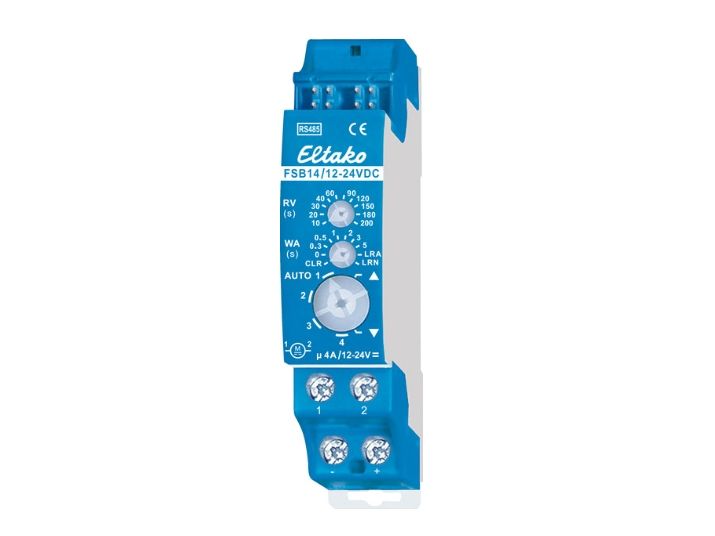
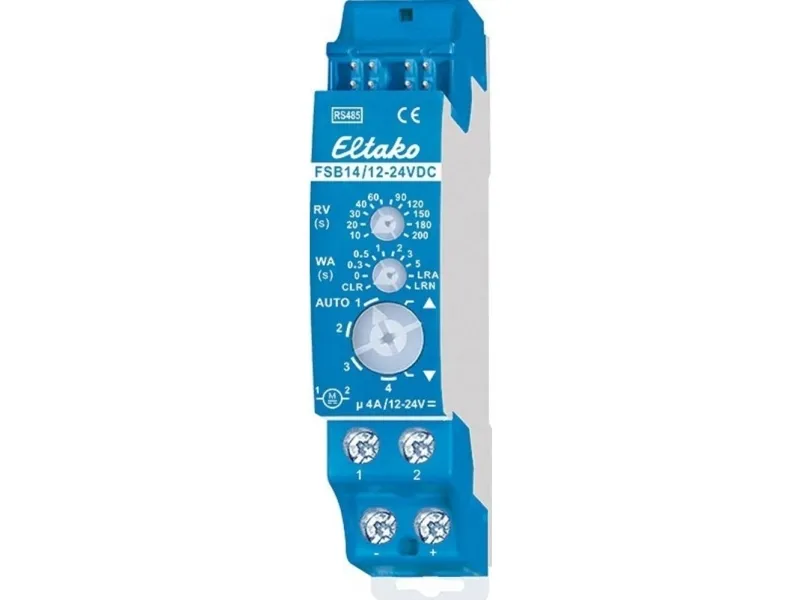
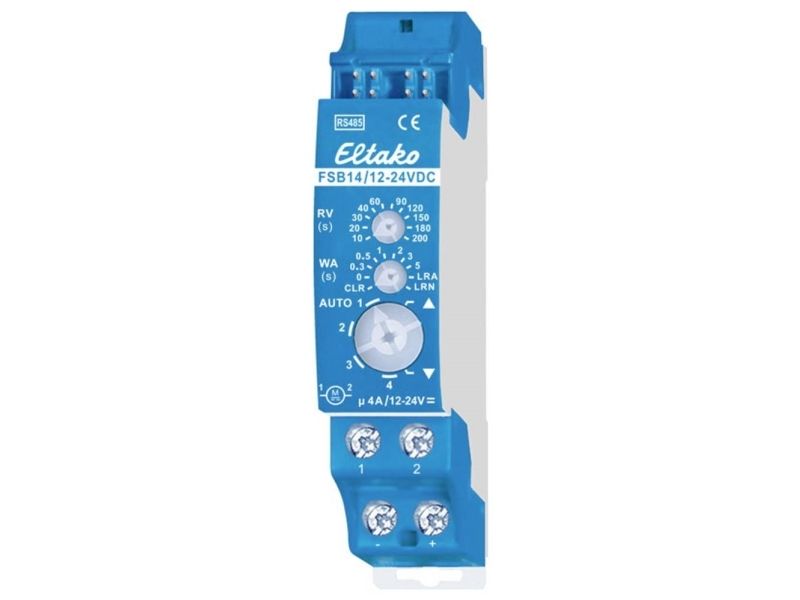
2-channel impulse switch with integrated relay function, 1+1 NO contacts potential free 16A/250V AC, 230V LED lamps up to 400W, incandescent lamps 2000 watts, with DX technology. Bidirectional. Only 0.1 watt standby loss. Modular device for DIN-EN 60715 TH35 rail mounting. 1 module = 18mm wide, 58mm deep. Connection to the Eltako RS485 bus. Bus cross wiring and power supply with jumper. Patented Eltako Duplex technology allows you to switch normally potential free contacts in zero passage switching when 230V A/C voltage 50Hz is switched. This drastically reduces wear. To achieve this, simply connect the N conductor to the terminal (N1) and L to 1(L) and/or N to (N2) and L to 3(L). This results in an additional standby consumption of only 0.1 watt. If supply voltage fails, the switching state is retained. When power is restored, the device is switched off in defined mode. The channels can be taught-in as ES and/or ER channel separately from each other. Scene control: Several channels of one or several FSR14-2x devices can be switched on or off in a scene by one of the four signals of a pushbutton with double rocker taught-in as a scene pushbutton. Central commands can be sent using a wireless pushbutton and/or with a controller. Use the rotary switches to teach-in the pushbuttons and test the 2 channels as required. For normal mode, the middle and lower rotary switches are then set to AUTO. With the upper rotary switch the EW time (0-120 seconds) is directly set for relays or the RV time (0-120 minutes) for impulse switches for all channels if necessary. If wireless motion/brightness sensors FBH (Master) and/or FBH (slave) are taught-in, the switching threshold will be set with the upper rotary switch, separated for each channel, at which the lighting will be switched on or off. Settings of the upper rotary switch in accordance with operating instructions. When wireless brightness sensors are taught-in, define the switching threshold separately for each channel using the top rotary switch. The switching threshold switches the lighting on or off depending on the brightness (from approx. 0 Lux in position 0 to approx. 50 Lux in position 120). A hysteresis of approx. 300 Lux is permanently set for switch on/off. An additionally set RV time is not taken into account. Only one FBH (Master) or FAH can be taught-in per channel. However a FBH (Master) or FAH can be taught-in into several channels. When wireless window/door contacts FTK or window handle sensors FFG7B are taught-in, different functions can be set with the middle rotary switch in position AUTO 1 to AUTO 4 and linked to maximum 116 FTKs: AUTO 1 = window closed then output active. AUTO 2 = window open then output active. In settings AUTO 3 and AUTO 4 the FTKs taught-in to a single channel are linked automatically. With AUTO 3 all FTKs must be closed so that the N/O contact closes (e.g. for climate control). With AUTO 4 one open FTK is sufficient to close the N/O contact (e.g. for an alarm signal or to switch on the power supply for an extractor hood). One or several FTKs can be taught-in in several channels to allow several simultaneous functions in each FTK. After a power failure the link is restored by a new signal to the FTK and a signal on the next status message 15 minutes later. An additionally set RV time is not taken into account. Function with wireless smoke alarm detectors FRW or water sensors according to the operating instructions. The LED below the upper function rotary switch performs during the teach-in process according to the operating instructions. It shows control commands by short flickering during operation.
DIN-Schienen-Montage
Ja
Internationale Schutzart (IP-Code)
IP20
Produktfarbe
Blau
Maximale Schaltleistung
2000 W
Spannung
12 V
Stromstärke
16 A
Das Produkt hat folgende Artikelnummer in unserem System
EAN:
4010312326701
SKU:
ELT-30014079
Warum ist ein und dasselbe Produkt unter verschiedenen Artikelnummern erhältlich?
Hersteller bringen oft dasselbe Produkt unter verschiedenen Artikelnummern auf den Markt, in der Regel handelt es sich dabei nur um unterschiedliche Versionen der Verpackung. Die Verpackung kann zum Beispiel für verschiedene Länder bestimmt sein.
Wir versuchen unser Bestes, um die Produkte zu vereinheitlichen, aber es kann vorkommen, dass dasselbe Produkt unter verschiedenen Artikelnummern in unserem System erscheint.